
Количката е празна
Equivalent Units FIFO Method Example
Since they are halfway done, it’s like having 100 fully completed chocolate bars. This helps the factory calculate costs more accurately for the partially finished products. We want to make sure that we have assigned all the costs from beginning work in process and costs incurred or added this period to units completed and transferred and ending work in process inventory.
Physical Units
- But it is not 50% complete with respect to the direct materials themselves.
- Understanding how to calculate equivalent units is a fundamental concept, particularly in the context of process costing.
- So the number of units transferred is the same for material units and for conversion units.
- Ending work in process is 1/3 complete for conversion costs, but what about materials?
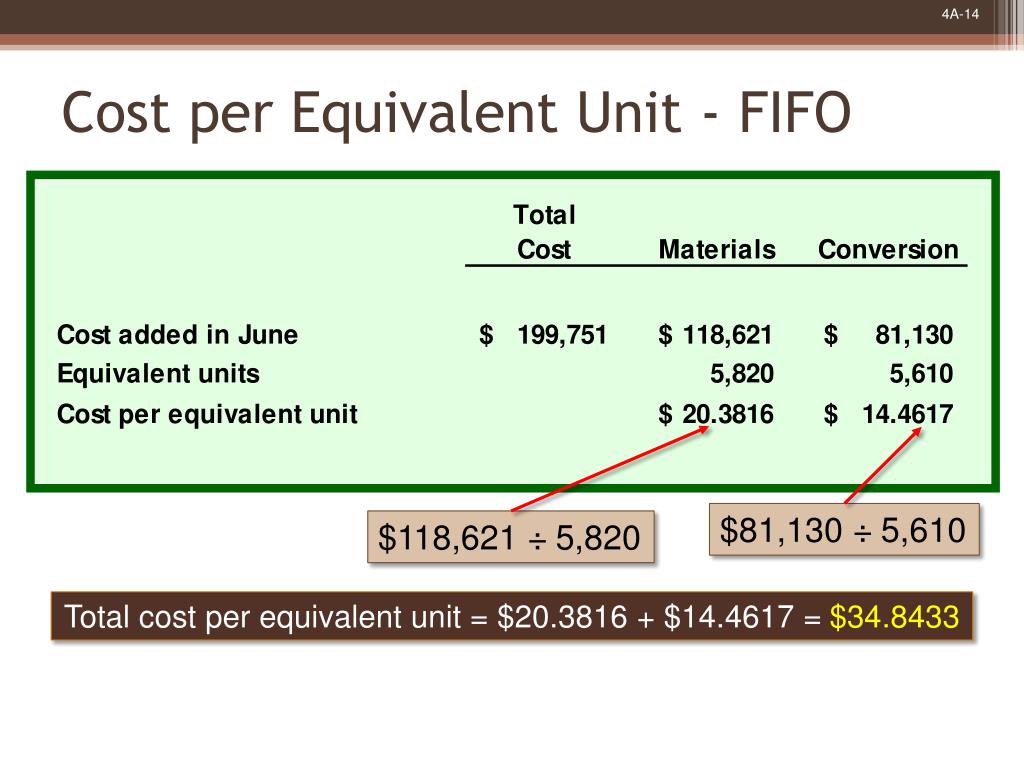
- Once the equivalent units for materials and conversion are known, the cost per equivalent unit is computed in a similar manner as the units accounted for.
InDepartment B, the ending units may be in different stages ofcompletion regarding the materials, labor, and overhead costs.Assume that Department B adds all materials at the beginning of theproduction process. Then ending inventory would be 100% complete asto materials since we received all materials at the beginning ofthe process. We must first FINISH beginning work in process, add units started and completed and units remaining in ending work in process.
Process Costing
When Department A is done with some product units and passes those units onward to Department B, then we credit the WIP-A account for the cost of those units and debit the WIP-B account for the cost of those units. Let’s say your department cooks dumplings (a prior department prepared the dumplings; your job is just to cook them). In the next page, we will do a demonstration problem of the FIFO method for process costing. The units that remain in the ending work-in-process inventory, however, are not complete.
6: Process Costing (FIFO Method)
We could then add these equivalent units to the ending WIP inventory for process 1. Any units that have been moved into process 2, will be subtracted from the WIP inventory for process 1. First, FIFO only applies this period‘s rate to work done this period. So, the beginning WIP equivalent units are subtracted away in order to arrive at “Equivalent units completed with this period’s work” (see cells E4, E11, and E18). That removes the portion of beginning WIP units that were completed last period. Well, ending WIP cost is important so the firm can determine the value of inventory accounts on its balance sheet.
At the end of process 1, our planners have their paper and ink ready to be printed. Let’s assume we figure the ending WIP inventory to be 35% complete as to the process. If we have 1000 units in the ending WIP inventory after process 1, this would equal 350, using the formula for equivalent units.
Get Started
That amount is either debited to the next department’s WIP account or to finished goods (if this is the last department in the production chain). While this is indeed the basic structure of process costing, there are three big complications. In our next section, we will do a comparison and reconciliation of the same number of products through one process with each of the two methods. The articles and research support materials available on this site are educational and are not intended to be investment or tax advice.
The cost of each element (i.e., material, labor, and overhead) is divided by the equivalent units of production of that element. Mathematically, this is done by converting the partially completed units into fully completed units and then adjusting the output figure. Notably, “equivalent units completed with this period’s can an llc file a 2553 work” is calculated the same as in the first set of brackets below. This is always the case when there are beginning WIP equivalent units. If there are no beginning WIP units, the two methods operate in exactly the same way. Again, the only difference between the two methods is that stinking beginning WIP.
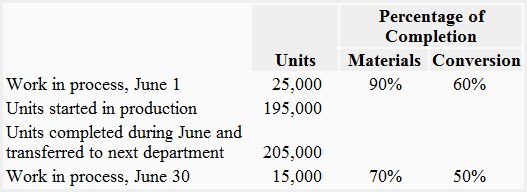
Although each department tracks the direct material it uses in its own department, all material is held in the material storeroom. The first stage in Navarro’s production process is the Melting Department. Navarro started the month of June with 300,000 tons of iron ore in process in the Melting Department. During June, an additional 600,000 tons were introduced into the melting vats. The table below summarizes the movement of physical units during the accounting period. Using the same example from the weighted average method, let’s use the following facts.
The equivalent production for each department is determined, which is later used to calculate the cost per unit of each job order by apportioning their total costs on basis of equivalent units. Under FIFO, remember to bring over the costs of beginning work in process first, then multiply the individual equivalent units calculated in step 2 (not the total equivalent units) by the cost per equivalent unit from step 3. The total equivalent units (i.e. TEU) for our three process costing categories are calculated as follows. Process costing firms usually have several departments that products must pass through before they’re complete.
This makes it easier to calculate costs when there are many different costs over a period. First, we need to know our total costs for the period (or total costs to account for) by adding beginning work in process costs to the costs incurred or added this period. Then, we compare the total to the cost assignment in step 4 for units completed and transferred and ending work in process to get total units accounted for. First, we need to know our total costs for the period (or total costs to account for) by adding beginning work in process costs to the costs incurred or added this period. If an alternative weighted average method is used then the beginning WIP units are treated as started and completed (100%) during the accounting period. The treatment using this method is discussed in our equivalent units of production- weighted average method tutorial.
At the end of the period, the firm determines ending WIP percent completion and determines units completed. Then the firm engages the following cycle to determine where the costs go. The overall objective of process costing is to take these costs and redistribute them between (1) ending WIP and (2) the credit side of the WIP account (i.e. completed and transferred out costs). The overhead cost per unit number has now transformed into an overhead cost per equivalent unit number. To reiterate, this allows the overhead cost we allocated to ending WIP units to be scaled by those ending WIP units’ percent completion. In Chapter 4, I made a parenthetical comment about dividing overhead evenly between individual product units.